Friday, 9 January 2015

Dancing queens

21/11/14
A decision to hang out downtown with some friends turned into a random afternoon exploring an art college where we watched some student presentations and stumbled on a ballroom dancing competition. The competition was a stroke of luck while waiting for the art class to finish preparing their presentations we spotted some girls in sparkly dresses on the street below. We went to investigate and somehow managed to sneak our way into the dance hall (it was closed to the public). We found ourselves in the midst of couples all lined up waiting anxiously for their turn to dance.

I found their faces most intriguing to watch: some looking nervous and jittery; others with a fierce look of concentration; some were counting during the dance; others had pasted a smile on for the judges. You could usually tell how their dance had been judging by their faces as they came off the dance floor: some looked close to tears while others were elated.

The girls’ outfits were also a point of interest: bright swooshing skirts, open backs, glitter and sparkles everywhere, fake long lashes and gelled hair with flowers and tassels woven in. Even after exiting the dance hall, we stayed sitting on the sidewalk for a long time watching the dancers coming and going. As we were leaving, the girls had changed into some more carnavalesque outfits with flashy colours, short skirts with tassels, shakers or frills and a bit of animal print.
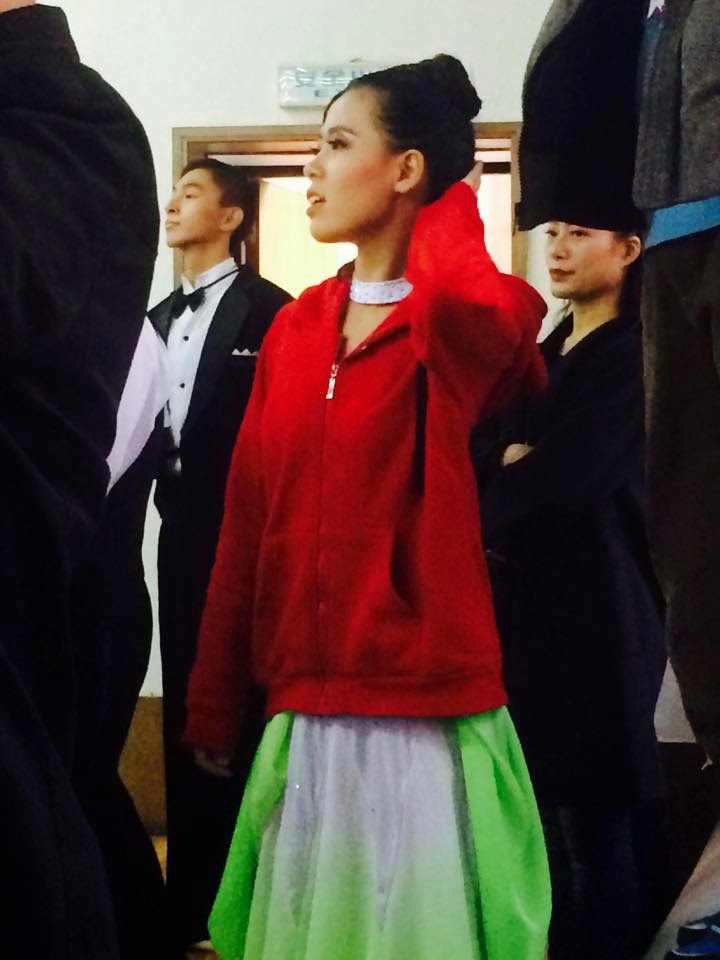
A dancer checking out her competition while waiting her turn.
photo credit: Frances Wintjes Clarke

One girl in particular drew my attention, because unlike the others, she was not a stick figure. She had more Mongolian features with a very round face, big cheeks, broad shoulders and wide hips. She had a very generous smile and secretly I hoped that she would win. I wondered how the others might perceive her: if she gets teased or discriminated against for her size (she was about my size, so not fat, but big in comparison to most Chinese people) or if it is seen as normal? I also wondered how much their appearances counted for in the dance competition: were their appearance and outfits also being judged? Were the costumes mandatory? What would happen if someone just showed up off the street wearing no makeup and the clothes they wear to go to work and just started dancing? Would they be judged the same way as the others based on their ability as a dancer or would they be disqualified because of their appearance?

After the ballroom show, we found a group of breakdancers practicing in a park. Their leader was a young woman with a peculiar hairstyle, baggy clothes and visible tattoos. She was intriguing in part because she was the first Chinese person I saw with tattoos and in part because she was one of the rare women in China I saw that wasn’t girlish. Attitude usually comes with being a breakdancer, but it was refreshing to see a woman not acting out the role of a delicate flower for once.

On the way home, I chatted with a buddy about the film her group had watched on the cultural revolution (Farewell my concubine). As we discussed some of the horrors of the cultural revolution, the buddy told me that Mao was not to blame, but that his wife, Jiang Qing, was responsible. “According to official Chinese history [Jiang Qing] shoulders the blame for the evils of the cultural revolution” while Mao remains their infallible great leader who can do no wrong (Schaffer & Xianlin, 2007). Of course, there is nothing surprising about the woman being blamed for history’s mistakes. And while Jiang Qing certainly did do some bad things, it should be recognized that she wasn’t acting alone.

While researching influential women in Chinese history, I found that most famous women who at some point seized power were portrayed negatively in the annals of history. Women like Wu Zetian and Cixi who were two of the most powerful women in Chinese history are described as power hungry and ruthless villains; however, as Wikipedia helpfully points out, “she was no more ruthless than other rulers” at the time. It all comes back to the whole double-standard thing where if a man acts aggressively then he is showing strength and being a good leader, but if a woman acts in the same way than she is labelled a villain and a b*tch.

Not to mention that women are often discredited by attributing their success to their beauty rather than their skills or cleverness. Both Wu Zetian and Cixi were considered beautiful and started off on their road to power as concubines. Mao also had a preference for young, modern, pretty women like Jiang Qing who started off as an actress and became the face of the revolution as the head of the Communist’s Party Propaganda Department (Ip, 2003). Myths like the four beauties reinforce this idea that women must “exploit” their beauty and sexuality in order to gain power by seducing, manipulating and even distracting their opponents. Under the cultural revolution the “deployment of feminine beauty for political ends” was known as the “beauty tactic” in which women used their appearance to advance the political and ideological goals of the revolution (Ip, 2003).

Even today beauty plays a significant role in establishing power and women in politics are often scrutinized and discredited based on their looks. It all comes back to what our buddy said: that if a woman isn’t beautiful enough, then no matter what she does it will never be good enough. This has got to change. There are some brilliant and beautiful minds out there, who regardless of their physical appearance, deserve to have their ideas, their talents and skills recognized and appreciated. These people have something real and valuable to contribute to the world and it both disgusts and saddens me when their work is minimized and cheapened by superficial concerns. Like my hypothetical dancer from before; she could be the most phenomenal dancer out there, but if she doesn’t look the part then she probably won’t win the prize…


Ip, H.-Y. (2003). Fashioning Appearances: Feminine Beauty in Chinese Communist Revolutionary Culture. Modern China, 29(3), 329-361. DOI: 10.1177/00977004032
Schaffer, K. & Xianlin, S. (2007). Unruly Spaces: Gender, Women's Writing and Indigenous Feminism in China. Journal of Gender Studies, 16(1), 17-30. DOI: 10.1080/09589230601116125

Dancers and performers reliving their glory days in People's Park, Chengdu


Traditional on the inside, modern on the outside

21/11/14
I wanted to address the topic of beauty in my blog because it has been a predominant theme throughout residency. It defines so many aspects of our lives and often unconsciously (or maybe consciously?) influences how we are treated and treat others.

My reflection starts on November 21 when we held a focus group with my team members and our Chinese buddies to discuss a romantic comedy (If you are the one) we had viewed together. The movie choice was that of our buddies.  Anyone who knows me can tell you that rom-coms are not really my thing, but from an academic perspective they provide some interesting topics for discussion.  Universal themes such as love, marriage, family values, sex & sexuality, fidelity and beauty provided us with endless fodder for discussion. 

One of the things that struck me and my team members was the way women were represented in the movie (I was lucky enough to be on a team of awesome feminists).  The storyline consisted of a man searching for a wife through online dating. In his personal ad the protagonist writes: “looking for a woman who is traditional on the inside but modern on the outside”.  Meaning a woman who is willing to cook and clean and accommodate her husband’s needs but who is also beautiful and stylish so her husband can show her off when he goes out. “Chinese women today are expected to possess traditional Chinese virtues, such as being submissive and nurturing, along with physical beauty according to an Anglo-European standard” (Zhang, 2012).

Throughout the film a series of stereotyped women were paraded in front of the protagonist; the traditional woman, the career-oriented woman, the prude woman, the unwed pregnant woman, the “goddess”… All of them flawed, failing to meet the standards of perfection laid out in the image of the “ideal” woman. In The Beauty Myth, Naomi Wolf (1991) compares beauty to an economic system in which women are each assigned a value based on their physical appearance which helps maintain the institution of male dominance by forcing women to compete with each other. Similarly, in the film the women were all evaluated and judged by the male protagonist according to a set list of criteria that he had outlined in his “profile”.

Brides in red (traditional) or white (modern) dresses were often found doing photo shoots in various sites. 
photo credit: Hope Hickli

We are on a quest to find perfection. Even the question “what do you look for in a partner?” implies that there is a list of criteria somewhere that a person must meet in order to qualify as a “match”. The problem is not having a preference for certain attributes or qualities in a person, but it is when we rely on those “lists” unquestioningly. It becomes a problem when we come to believe that circles are the only real shape and that all the other shapes should look like circles. It becomes a problem when all the squares, triangles, stars and octagons feel they need cosmetic surgery in order to fit into the circle hole. It becomes a problem when people are made to believe that they aren’t good enough or worthy enough of love because they don’t fit the criteria dictated by society.

The issue of worth was raised when the topic turned to fidelity. One of the buddies had asked what people thought of the female protagonist, who was having an affair with a married man, and whether or not she was to blame for the affair. During the discussion, the only man in the group commented that a man would be justified in looking somewhere else for satisfaction if his wife is “not beautiful enough or excellent enough”.  In other words, dignity and respect are not inherent in a relationship, but rather depend on a woman’s ability to fit inside the circle hole. This also implies that regardless of what the man did, the woman is to blame because if he did something wrong (like cheating) it was because she wasn’t good enough; therefore, the fault is hers even if he is the one who consciously committed the act. See what I’m getting at here?

As a result, beauty is not only a significant factor in finding a partner, but also plays a crucial role in a woman’s supposed ability to maintain the relationship and secure her boyfriend/husband’s fidelity. This could explain why some women will continue to make painstaking efforts to look young and beautiful even in their old age. I recognize that men also go through a lot of pressure to look good in order to attract beautiful women, but once they are married they stop trying. Women, on the other hand, continue to grasp at their youth, fearing old age and the possibility that their partner will leave them for someone younger and more beautiful.

Young women will often pay for a photo shoot in order to preserve their youth and beauty.
photo credit: Fiona Cheong 

Beauty is closely related to age with many people associating youthfulness with attractiveness and fertility. As a result, there is a significant amount of pressure placed on young women to get married before they are 30 years old. The deadline to get married came up several times in conversations with buddies who also informed us that some girls will keep a “backup” boyfriend on hand so that she will have something to fall back on if she doesn’t find “Mr. Right” before she turns 30. For some people, it is better to settle than to end up a spinster (possibly for the rest of your life). However, things appear to be changing because most of the people I spoke to, both men and women, said they would prefer to wait for the right time and the right person rather than get married before 30 just because they feel they have to. It’s just as well because I turn 30 next year so hopefully this shift towards a more liberal attitude towards marriage can buy me a few more years before I earn the spinster title.

Zhang, M. (2012). A chinese beauty story: How college women in china negotiate beauty, body image, and mass media. Chinese Journal of Communication, 5(4), 437-454. doi:10.1080/17544750.2012.723387
Wolf, N. (1991). The beauty myth: How images of beauty are used against women. Random House.


I have no idea what this is or what it represents - only that it is awesome. 

Transformer beauty - made by staff at the Hangzhou Waste Facility using old parts of machines and dump trucks. Titled: "Nothing is impossible."
photo credit: Andrew Staples


Girls on bicycles


18/11/2014
I was quietly enjoying my stroll along the walkway across west lake – It was a beautiful sunny day and I had just ditched my cohort because I couldn’t take the faffing and indecisiveness anymore (try moving a group of 40 plus people all together through the metro and you’ll get why I didn’t hold up my previous resolution to stay with the group and be a better participant!).  Families, friends and couples were out enjoying the day with a stroll, trolley ride or cycle across the overpass.  I was elated to be near water again and watched the boats go by with envy. I longed for my canoe so that I could just push off across the lake with paddle in hand, feeling the water underneath me.
I was feeling at peace with the world – as I do when I am near water – when I saw the first one…

The young girl was riding her bike with her friend and when they reached the bridge he continued peddling up and over while she stopped at the bottom, hopped off the bike and walked over the bridge. I saw this happen two or three more times and each time I would get even more worked up. I wanted to grab the bike out of their hands and show them how it is done. I wanted to show everyone that women too could ride up hill (it wasn’t even a hill!!).

The thing that really got to me about the whole scene is that the girl wouldn’t even try to make it over the bridge; she wouldn’t even go half way…She just got off and walked as if there was an invisible hand stopping her from going any further. I assumed that maybe it was because she didn’t want to look ungraceful and indelicate huffing and puffing her way up the hill. I can’t stand watching women play the role of the weak and delicate flower any more than I can stand men playing the role of the strong and gallant hero come to save the damsel in distress.

For a long time afterwards, I reflected on the experience and in particular, questioned my reaction to what had happened. Why did I get so worked up over a few girls walking their bikes over a bump? Was it really that big a deal? Was I overreacting?

I realized that my upbringing and cultural values led me to interpret women walking their bikes as a sign of weakness. I don’t know the actual reason why they were walking their bikes, nor can I explain how this act was perceived or defined by Chinese cultural standards, but to me it sent the message that women are weak and delicate and should not exert themselves physically for fear of messing up their makeup.
It reminds me of a passage citing Carol Hanisch in bell hooks’ From margin to centre (1984):

Women don’t want to pretend to be weak and passive. And we don’t want phony, weak, passive-acting men any more than we want phony supermen full of bravado and little else. What women want is for men to be honest. Women want men to be bold – boldly honest, aggressive in their human pursuits. Boldly passionate, sexual and sensual. And women want this for themselves.
But is that really what women want? It is not unusual here to see men carrying their girlfriends’ purse or holding the umbrella for them…Weak and passive women and men full of bravado might not be what I want, but I can’t speak for everyone. In China as in many places, men are expected to be gallant and chivalrous while women are expected to be docile; grateful to men for their protection and admiring of men for their strength and courage.

Beauty, in this case, becomes not only an issue of how someone should look, but also how they should act and what they should or shouldn’t do. In the words of Naomi Wolf (1991), “The beauty myth is always actually prescribing behavior and not appearance”.  It can limit one’s capabilities by suggesting that certain activities are unattractive or undesirable for one gender or the other. Like sweating; sweating is not considered sexy in most places, which is why some girls might prefer to walk their bike than to break a sweat trying to peddle their bike uphill.

In my classes we often use the term “losing face” to describe how people act to preserve their dignity. “Face” refers to people’s egos or pride, and therefore, “losing face” means anything that would damage someone’s ego or make them look bad. In China, looks also indicate socioeconomic status and character traits so looking sweaty and dishevelled might be interpreted as someone who is lazy, lower class or uneducated.  Similarly, in Cameroon, a common insult was to call someone a “villageois” (villager) which means someone who is uncivilized, unsophisticated and ignorant. Generally, this was also attributed to anyone who looked unfashionable or unattractive.

I feel a bit like a villageoise in China. I am too rough around the edges for Chinese society. Delicate, elegant, sophisticated and fashionable are not words that you could use to describe me, yet they have come up several times in conversations as desirable traits that people look for and expect in a woman. Where I come from, however, more value is placed on characteristics of independence, self-sufficiency and toughness. Yukoners, and northerners in general, often pride themselves on their ability to withstand harsh conditions; to endure and survive. Physical exploits and tough challenges are prized and celebrated. We attempt crazy feats just so we can brag about it later. For me, losing face means pushing my bike up the hill, doing the “walk of shame”. Beauty, while still an important concept in the North, is not necessarily associated with the same traits of delicateness, sophistication and elegance that you find here in China; reinforcing the fact that beauty is relative to different people and contexts.

Hooks, B. (1984). Feminist theory: From margin to center. Cambridge, MA: South End Press
Wolf, N. (1991). The beauty myth: How images of beauty are used against women. Random House.


Pictures from my walk around West Lake


I am beautiful. You are beautiful. We are all beautiful.

Every generation since about 1830’s has had to fight its version of the beauty myth. “It is very little to me,” says the suffragist Lucy Stone in 1855, “to have the right to vote, to own property, etc. if I may not keep my body, and its uses, in my absolute right.” … In spite of the great revolution of the second wave, we are not exempt. Now we can look out over ruined barricades: A revolution has come upon us and changed everything in its path, enough time has passed since then for babies to have grown into women, but there still remains a final right not fully claimed.
The Beauty Myth, Naomi Wolf (1991)

Everyone wants to feel beautiful, to feel desired and to feel loved. Although being beautiful is in no way a prerequisite for being desired or loved, there is a strong correlation between the two that leads people to believe that they must adhere to certain standards of beauty in order to be perceived as attractive and desirable. We make assumptions about beautiful people, often associating beauty with other qualities such as youthful, elegant, modern (fashionable), sophisticated and educated/intelligent.
 
We often hear people state that beauty in the sense of physical appearance is not important. However, from what I have observed in my own experiences and from conversations with others, not only does beauty matter, but it has a significant impact on our identities, social relationships and lives. Beauty might only be an idea, a construct of our collective imagination, but it becomes real and concrete by inserting itself into people’s daily lives: influencing everything from what we wear, to who we marry and how we live (Wolf, 1991).  Any kid who has been bullied in school; anyone who has ever gone for a job interview; anyone who has ever been on a first date knows that appearances matter.

How we define beauty and the standards of beauty may vary depending on cultures, personal preferences and current fashions but the impulse to seek out and appreciate beauty exists wherever we look.  The “admiration of beauty, the belief in the desirability of being beautiful and the practice of self-beautification” are present throughout history and the world (Ip, 2003). The beauty industry, known in China as meinu jingi (beauty economy), is composed of some of the largest and most profitable industries in the world, including diet, cosmetics, cosmetic surgery, and pornography (Zhang, 2012).  The central importance of beauty in the corporate economy and its institutionalization ensures that the “the beauty myth” will never die, but will continue to be perpetuated through the media and popular beliefs.

I wanted to address the topic of beauty – and specifically the influence of cultural concepts of beauty on our social interactions - in my China blog because it has been a prominent subject during residency and has been featured in many conversations with other members of my cohort and our Chinese buddies. Personally, my own interest in the topic stems from my own feelings of insecurity that were brought to the surface in China. As a result, the following posts are a compilation of reflections on cultural perceptions of beauty as well as my own attempt to understand how beauty concepts influence how I perceive myself and how I interact with others.

The first post (Girls on bicycles) deals with my own struggle with feeling insecure and out of place in China; the second (Traditional on the inside, modern on the outside) discusses linkages between “beauty” and relationships; the third (And we danced) addresses how beauty interacts with notions of power, talent and skill; the fourth (Pearls are a girl’s best friend) explores the transition from “beauty fear” under Communism to “beauty fever” in modern day society; finally, in the fifth post (HERstory) I take a look at the post-revolutionary reclamation of “feminine beauty” by Chinese women writers, activists and leaders in the context of my team’s exhibition celebrating women in China.

It should be noted that in my posts I write primarily from a women-centered perspective and draw from examples of how beauty impacts mainly women’s lives. I write from this stance primarily because I am woman-identified and so this perspective also reflects my personal experiences. However, I acknowledge and appreciate that both men and gender queer or gender neutral people also face similar pressures to conform and meet certain standards of physical attractiveness. For example, during our team exhibits, one of the teams whose topic was relationships asked the question: “what do you look for in an ideal partner?” Many women responded that they wanted someone handsome and tall. Similarly, I found this personal ad in a park of a woman searching for a husband who must be at least 1,75m tall. These examples demonstrate that men are also pressured to appear a certain way and possess certain desirable attributes.


But who decides what is desirable? I won’t go into details about where standards of beauty come from or how they are constructed, but rather will focus on what kind of impact these constructions have on our social relations. My musings here are not intended as a comprehensive study on the topic of beauty, but rather reflect my thoughts and learning while in China. Nevertheless, my writings will be more academic than usual, since I am, after all, a master’s student (fake it to make it all the way!). Luckily, most of you will already be familiar with my philosophical ponderings and feminist rants so I don’t feel the need to tone it down. 

As a final remark, I want to note that although I will be discussing concepts of physical beauty, there are alternative definitions of beauty that relate to natural, artistic and human (“inner”) qualities. In this sense beauty can also refer to the compassion, caring, resilience and generosity of the human spirit. This is dedicated to all the truly beautiful people in my life who support and inspire me.

* Wolf, N. (1991). The beauty myth: How images of beauty are used against women. Random House.
**Ip, H.-Y. (2003). Fashioning Appearances: Feminine Beauty in Chinese Communist Revolutionary Culture. Modern China, 29(3), 329-361 DOI: 10.1177/00977004032
***Zhang, M. (2012). A chinese beauty story: How college women in china negotiate beauty, body image, and mass media. Chinese Journal of Communication, 5(4), 437-454. doi:10.1080/17544750.2012.723387

Tuesday, 30 December 2014

On being "interculturally competent"

One thing we keep hearing repeated is that when we are experiencing a “different culture” we must keep an open mind. In cultural studies, having an open mind is one of the criteria for being “interculturally competent” – that is being able to adapt and integrate and communicate well within different cultural contexts. However, the realization that I came to today, is that keeping an open mind is easy when it is on my own terms.

I have traveled solo a lot and so I have no trouble when it comes to adapting to different cultures so long as I can do it my way. The challenge for me during this residency will be to learn how to adapt to traveling with a group and to get along with others who share the same nationality (and supposedly the same culture) as me. The lessons I need to learn during this residency involve learning to participate fully in the group (by staying with the group and not wandering off to do my own thing!) and having a good attitude (playing nice with the others in my cohort). I find it easy to get along and make friends with locals, but how do I interact with other Canadians? I need to try to keep an open mind and heart not only when it comes to other cultures and nationalities, but also when I am interacting with my own group/cohort.

Often when we talk about cultural differences, we refer to the obvious things like food, time and space concepts, transport systems, language and communication styles. But the real challenge lies in getting along with people who share different personalities, interests, values systems, political perspectives, religious beliefs, attitudes in life. Rather than always seeking out people who think the same way as me and share my views, I need to seek out people who challenge and question me.

Truly keeping an open mind means talking to people who I wouldn’t necessarily be drawn to immediately and spending time with people who I don’t have much in common with. This doesn’t mean that I have to be friends with everyone I meet nor do I have to pretend to make small talk with someone that I have absolutely no interest in talking to. But it does mean that I need to have a good attitude and be open to whatever conversation comes along my way. It means dropping my defenses and engaging with others rather than staying distant and unapproachable. It means I have to make an effort not to alienate everyone in the group by trying to be different, to set myself apart and to prove that I am not one of them. It means I have to let go of the fixed identity I have of myself as a loner, a gypsy traveller, the witch of Portobello. I need to soften my demeanor and suspend all judgement. All this is easier said than done, but at least I have completed the first step of just being self-aware and realizing what I need to work on myself. Today’s realization will help me commit to being a better person tomorrow. And maybe tomorrow I won’t be such a grouch anymore.


Saturday, 27 December 2014

Don't play with knives or sharp objects

One thing I didn’t expect was the level of security here in China (which seems obvious now, but when you come from the Yukon, you don’t really think about these things). In Beijing there are security checks around every corner. Every time you get on the metro and at the entrance to every tourist site is a security check. In particular, these security checks are supposed to verify any liquids (there have been cases of people lighting themselves on fire on public transport) and make sure you aren’t carrying any sharp objects that could be used as a weapon (a few months ago there was an attack on the metro where several people were stabbed to death).

My first few days in Beijing I made it through the security checks alright, mainly, I believe, because I am a foreigner and the security guards couldn’t be bothered to try to explain to me that they wanted to verify the contents of my purse (which contained both liquids and my leatherman). On the third day, however, I was stopped twice because I was with my Chinese friend who could act as a translator, but I was allowed to keep my knife because it is small (and I think the pliers confused them).

The real problem came when it was time to leave Beijing. I had planned to travel by train through China without knowing that you can’t take sharp objects with you onto trains either. This means that when I tried to go through security at the train station, I was stopped because I was traveling with my paddling gear, including my safety knife that is strapped to my lifejacket. A gentleman was called over and graciously acted as my translator as best as he could as I tried to explain to the security guards who spoke no English whatsoever why I was carrying a big knife and why they should let me keep it…Eventually, they allowed me to mail my knife to myself. Luckily, I had printed out my hotel address in Chinese before leaving so with only a little confusion we were able to figure everything out. However, this still leaves me with the dilemma of how I am going to get my knife from Hangzhou to Kathmandu if I can’t travel with it. Apparently, carrying knives isn’t really a thing in some countries…

Update: I managed to hang on to my knife throughout China and bring it to Nepal where the authorities are way to disorganized to have any kind of security checks so no one bothers with my knife.

Blue skies - I was lucky enough to be in Beijing at the same time as the APEC conference so factories were shut down and traffic was limited to give a good impression.

Hanging out on the great wall.

Mutianyu Great Wall

Pagoda in Jingshan Park

The Forbidden City

Pavilion

Saturday, 22 June 2013

Beach!

What do you do when you find yourself evacuated, forced out of work, in limbo, bored and in a foreign city? Go to the beach of course!

Que faire quand tu te fais évacué, en congé forcé, ennuyé et dans une ville étrangère? Aller à la plage bien sûre!

Djawe
 
 Kembo

 My nouveaux colocs. My new roommates.
Acke, Marianne and Kembo


 Kembo's first swim in a lake.

 Kembo n'a pas trop aimé sa première experience dans l'eau...

 He cried at first but eventually came around to having fun.

 Marianne se prépare pour sauter à l'eau.


 Kembo avec tonton Djawe

 Les villageois qui embarque pour la première fois dans une pirogue...


Ta-dah!